

"In the modern metal processing industry, heavy gauge cut to length lines are mainly used for processing thick metal coils such as hot-rolled steel, carbon steel, and stainless steel with a thickness of 6-25mm. They produce high-quality metal sheets widely used in construction engineering, machinery manufacturing, container manufacturing, shipbuilding, bridge construction, and many other fields. Compared to conventional standard cut to length lines, heavy gauge cut to length machines process materials with significantly greater thicknesses, thus requiring special considerations in equipment design, manufacturing, and component selection. Higher standards are needed for the robustness of the mechanical structure, the power of the power system, and the stability of precision control. This article will provide a detailed introduction to heavy gauge cut to length lines, helping you gain a comprehensive understanding of this important coil processing equipment."
What is Heavy Gauge Cut to Length Line?
The core function of a heavy gauge cut to length machine is to process thick metal coils (6-25mm) through a series of steps, ultimately cutting them into metal sheets of specific lengths to meet customer needs. Compared to standard cut to length lines, the biggest advantage of heavy gauge cut to length machines is their ability to efficiently process thick metal coils. Equipped with a more robust mechanical frame, higher-powered drive components, and stronger leveling capabilities, they effectively overcome the processing challenges posed by the high hardness, toughness, and susceptibility to deformation of thick metal materials. This ensures the dimensional accuracy and surface flatness of each finished sheet, meeting the stringent requirements of high-end manufacturing for thick plate processing.
Unlike standard cut to length lines, which focus on the efficiency of thin-film processing, heavy gauge cut to length lines are designed to address the various challenges in thick-plate processing. These include the difficulty of loading thick coils, the tendency for misalignment during uncoiling, the need to eliminate stubborn coil memory during leveling, and the need to overcome greater material resistance during shearing. Therefore, the selection and design of each component undergo rigorous calculations to ensure the long-term stable operation of the heavy gauge cut to length machine, achieving high efficiency and precision in thick-plate processing.
Heavy Gauge Cut to Length Line Process Flow
(1) Coil Loading and Uncoiling
Due to the large thickness and heavy weight of the metal coils processed by heavy gauge cut to length machines, ordinary decoiler cannot meet the requirements. Therefore, heavy gauge cut to length lines are equipped with heavy-duty mandrel-type decoilers, typically employing a double-cone structure. This structure can firmly fix the thick metal coils, preventing problems such as shaking and deviation during the uncoiling process. It also has a stronger load-bearing capacity, easily handling the loading and uncoiling of ultra-thick and ultra-heavy coils.
(2) Peeling and Leveling
The peeling table of the heavy gauge cut to length machine guides the uncoiled coil head smoothly into the heavy-duty leveling machine. Because the processed material is relatively thick (6-25mm), the number of rollers and pressure of ordinary leveling machines are insufficient to completely eliminate the bending deformation of thick plates. Therefore, heavy gauge cut to length lines are equipped with multi-roller heavy-duty leveling machines, typically employing a 6-roller or higher structure. Rigid support rollers are set on the outside of the upper and lower working rollers, causing the thick plate to repeatedly deform between the upper and lower rollers, effectively eliminating internal stress and achieving precise leveling. Meanwhile, the heavy-duty leveling machine is also equipped with a pressure regulation system, which can precisely adjust the roller pressure according to the different thicknesses and materials of metal coils. This ensures a smoothing effect while avoiding indentations on the surface of the sheet, thus guaranteeing the surface quality of the sheet.
(3) Measurement and Feeding
Because the thick plates processed on the heavy gauge cut to length machine require high length accuracy, a servo-driven feeder is used, paired with a high-precision measuring sensor, to achieve accurate measurement and uniform feeding of the sheet. When the smoothed thick plate enters the feeding stage, the servo-driven feeder precisely controls the feeding speed and distance according to preset finished product length parameters. Simultaneously, the measuring sensor collects the conveying length of the sheet in real time and feeds the data back to the control system for dynamic adjustment, ensuring the accuracy of the feeding length.
(4) Shearing
Due to the high hardness and toughness of thick metal materials, the shearing force of ordinary shearing machines is insufficient to complete the cutting. Therefore, the cut-to-length machines equipped in heavy gauge cut to length lines are specifically designed for heavy-duty operations, employing a bevel shearing mechanism. They are equipped with a high-power drive system and robust shearing blades made of high-carbon alloy tool steel such as Cr12MoV, and undergo precision heat treatment to achieve a hardness of HRC58 to 62.
(5) Stacking
The sheared finished plates are conveyed to a stacker crane via a conveyor line. The stacker crane stacks the plates in an orderly manner according to preset stacking parameters, adjusting the position of the plates in real time during the stacking process to ensure neat and secure stacking, avoiding problems such as tipping or tilting.
Key Features and Technologies of Heavy Gauge Cut to Length Lines
-Processing Range: Heavy gauge cut to length machines are mainly suitable for metal coils with a thickness of 6-25mm, covering various commonly used thick metal materials such as carbon steel, hot-rolled steel, and stainless steel, meeting the diverse needs of different industries for thick plate processing.
-Line Speed: The heavy gauge cut to length line operates at a speed of 25 m/min, employing stepless speed regulation technology to flexibly adjust the speed according to different materials and thicknesses of sheet metal.
-Leveler: To achieve better leveling results, the heavy gauge cut to length machine is typically equipped with a 6-roll leveler. Even for high-strength, thick metal materials, it effectively eliminates coil memory, ensuring excellent flatness of the sheet metal and meeting the precision requirements of subsequent processing.
-Robust Shearing System: The cut-to-length machine of the heavy gauge cut to length line uses a high-power drive system and wear-resistant blades, combined with a bevel shearing mechanism and precise gap adjustment function, enabling smooth cutting of thick plates and avoiding problems such as deformation and burrs.
-Durable Frame Structure: The frame and transmission system of the heavy gauge cut to length machine are reinforced and welded from high-strength steel plates, ensuring that the equipment will not deform or loosen during long-term heavy-load operation, guaranteeing the continuous stability of the entire production line.
Difference Between Heavy Gauge Cut to Length Line & Standard Cut to Length Line
From the perspective of processing objects, standard cut to length machines are mainly for thin metal coils with a thickness of less than 6mm, primarily processing thin steel and aluminum sheets. Heavy gauge cut to length machines, on the other hand, are mainly for thick metal coils of 6-25mm, processing thick plates with high hardness and toughness, such as hot-rolled steel, thick carbon steel, and stainless steel.
From the perspective of performance focus, standard cut to length lines prioritize processing speed and efficiency, with a maximum operating speed of up to 80m/min, enabling rapid batch processing of thin materials. Heavy gauge cut to length machines prioritize stability, strength, and leveling accuracy, with a relatively slower operating speed (25m/min), but maintain precise processing under heavy loads, avoiding deformation and deviations that can occur during the processing of thick plates.
From a structural perspective, standard cut to length lines have relatively simple mechanical structures, with lower power and load-bearing capacity in their core components. Heavy gauge cut to length machines, on the other hand, are equipped with more robust frames, higher-power drive components, multi-roller heavy-duty levelers, and heavy-duty cut-to-length machines. Their overall structure is more complex, with higher manufacturing standards, enabling them to meet various challenges in thick plate processing.
2025 Heavy Gauge Cut to Length Line Project
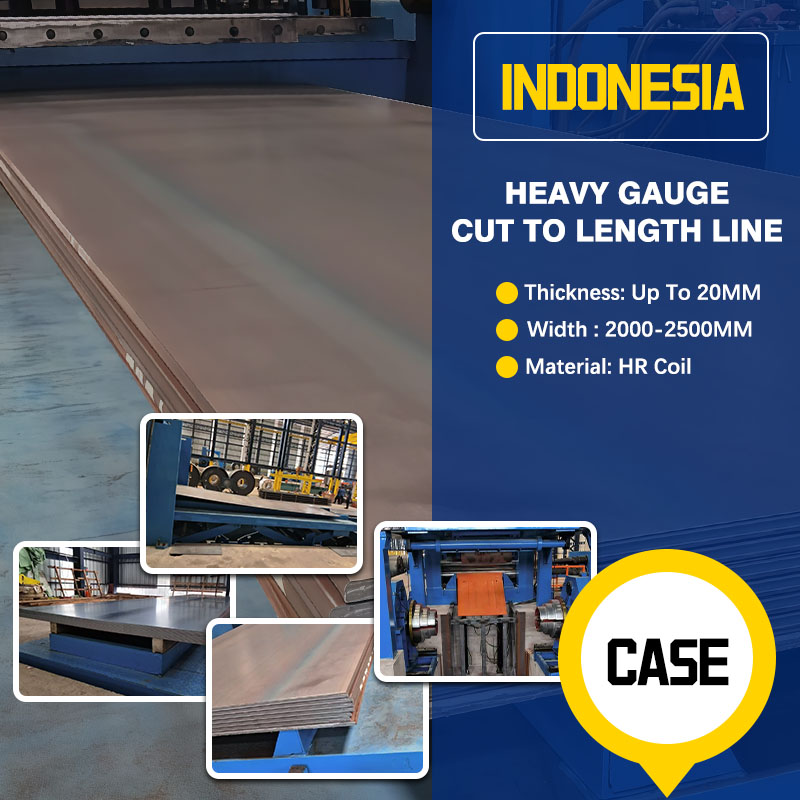
In 2025, KINGREAL SLITTING successfully completed the manufacturing of a heavy gauge cut to length machine customized for an Indonesian client. Designed strictly according to the client's requirements, this heavy gauge cut to length line can efficiently process 20mm thick hot-rolled steel coils, ensuring the precision and flatness of the finished plates. KINGREAL SLITTING also dispatched professional engineers to Indonesia to provide heavy gauge cut to length machine installation, commissioning, and operation training services, ensuring the client can skillfully operate the heavy gauge cut to length line and fully utilize its processing efficiency.
If you need more information about the process flow, technical parameters, and equipment customization of heavy gauge cut to length machines, please contact KINGREAL SLITTING. We will provide you with professional heavy gauge cut to length line manufacturing solutions to help you improve thick plate processing efficiency and product quality.