

In the field of slitting for medium-to-heavy metal plates, heavy gauge slitting lines perform the complete process of longitudinally slitting, sizing, and rewinding heavy-gauge metal coils—such as hot-rolled carbon steel, alloy steel, and stainless steel. Compared to light gauge slitting lines, heavy gauge slitting machines handle materials with greater thickness and rigidity and higher coil weights; furthermore, the significant differences in stress distribution across individual strips after slitting make tension control more challenging.
Effective tension control ensures precise strip widths, clean cut edges, reduced material waste, extended equipment lifespan, and stable, uniform rewinding. For metal processors aiming for high-quality slitting, low defect rates, and large-scale production, equipping heavy gauge slitting lines with precise, automatic tension control systems is crucial.
Core Definition of Tension Control in Heavy Gauge Slitting Line
Tension control in heavy gauge slitting machines refers to a comprehensive control technology that utilizes electronic control systems, mechanical buffering mechanisms, and tension-actuating components to monitor, dynamically compensate for, and precisely adjust the axial tensile force applied to the metal strip throughout the entire process—from uncoiling and pinch-leveling to slitting, intermediate transport, and final rewinding. Because the base materials processed by heavy gauge slitting lines possess significantly greater hardness, thickness, and span than those handled by conventional light gauge slitting line—and because the strips exhibit higher resistance to deformation, greater operational inertia, and stronger shearing impact forces—the tension across the production line must be precisely matched to the material's thickness, width, hardness, and properties, as well as the real-time production speed, to achieve dynamic tension balance throughout the entire operation.
In the context of actual production conditions, the precision with which tension parameters are matched directly determines the finished product's pass rate and the operational status of the equipment. Improper tension settings or excessive tension fluctuations in heavy gauge slitting machines can easily trigger a series of production defects, such as irreversible stretching of the metal strip, surface warping, edge waviness, center wrinkling, strip wandering, and breakage. Furthermore, uneven tension distribution accelerates the wear of slitting blades, conveyor rollers, and recoiling spindles, thereby increasing equipment maintenance costs.
Conversely, a precise and controllable tension system prevents residual internal stress, ensures uniform cutting speeds, and enables stable, high-precision, and continuous slitting operations; this minimizes scrap generation at the source and meets the standards for high-end plate processing.
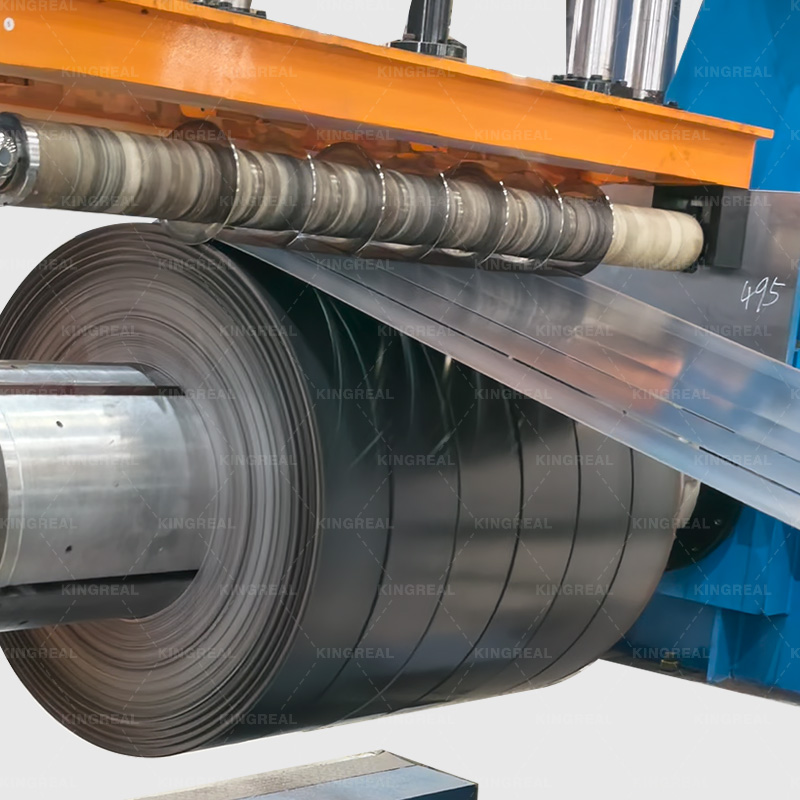
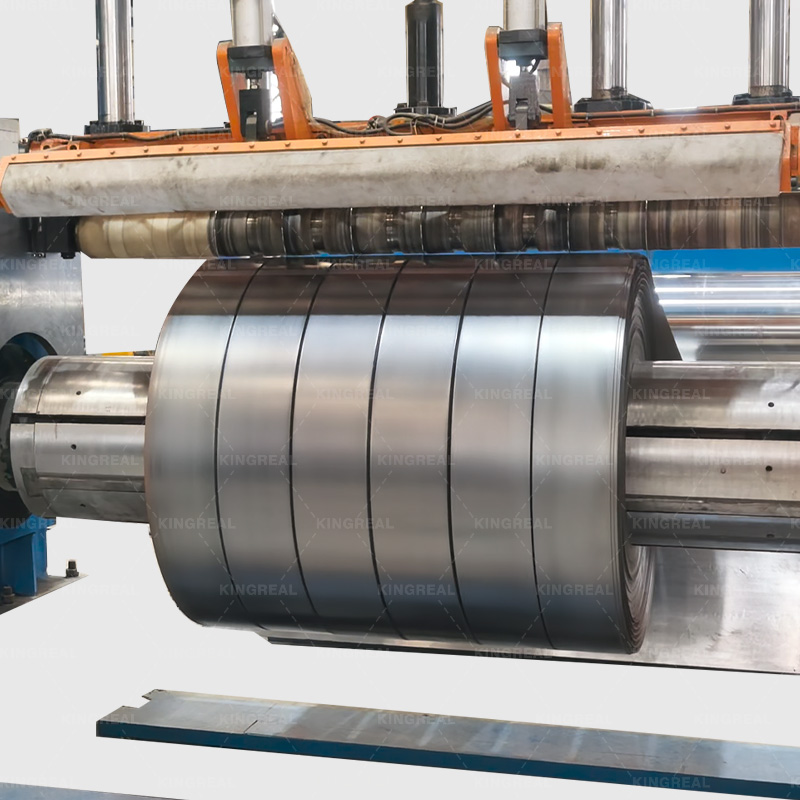
Tension Control Solutions for Heavy Gauge Slitting Machine
Heavy gauge slitting lines typically employ a combination of looper buffering structures and specialized tensioning units to regulate back-tension. This integrated approach simultaneously handles speed buffering, stress relief, and tension balancing, perfectly meeting the requirements for heavy-load, low-speed, and high-precision processing.
The overall operational workflow is as follows: after uncoiling and leveling, the heavy plate material enters the slitting section, where it is longitudinally cut into multiple independent, narrow strips. These strips pass through a looper pit to buffer stress and compensate for speed differentials. They are then precisely guided by two independent separation units into a unified tension station. Utilizing the tension station's core components in conjunction with coordinated control of the recoiler's torque and speed, a closed-loop recoiling tension system is established. This system counteracts the material's inherent spring-back stress and prevents coil defects such as internal looseness, interlayer misalignment, and end-face collapse. Finally, the finished coil is removed from the recoiling mandrel via an unloading mechanism and transferred to an exit cart for final transport. This integrated system achieves fully automated, coordinated operation among the three core units of the heavy gauge slitting machine: the main feeding unit, the slitting unit, and the recoiling unit.
Speedand force differentials between stations are completely neutralized by the looping pits and tensioning stations; consequently, no forced tensile stress is exerted on the heavy-gauge base material throughout the process, effectively preventing tensile deformation of the coil. Furthermore, during the slitting phase, the material undergoes free, compression-free shearing, eliminating the risk of lateral force deviation and resolving the common issue of strip wandering during the slitting of heavy-gauge plates.
Simultaneously, the tensioning station integrated into the heavy gauge slitting line delivers balanced tension across multiple strips and supports stepless overall tension adjustment. This capability not only accommodates the recoiling requirements for materials of varying types and thicknesses but also ensures uniform tightness across all slit strips, guaranteeing consistent quality for every finished coil.
Optimized Configuration of Dual Looping Pits
KINGREAL SLITTING offers a dual looping pit layout for heavy gauge slitting machines, optimizing tension zones along the line to specifically address issues such as loss of tension control at the coil ends and material damage. The functions of the dual looping pits are detailed below:
(I) Entry Looping Pit
The entry looping pit is positioned between the pinch-and-leveling unit and the rotary slitting shear, serving as a core structure for tension buffering in the infeed section. Equipped with laser position sensors, this unit monitors the accumulation height and position of the heavy-gauge strip within the pit in real time. It dynamically coordinates the feed speed of the upstream pinch-and-leveling unit with the cutting feed speed of the downstream slitter. This coordination eliminates sudden tension fluctuations caused by timing errors or speed mismatches at the infeed end, stabilizes the baseline infeed tension, prevents issues such as excessive feed speed (which could compress the cutters) or excessive tightness (which could stretch the base material), and optimizes tension stability in the infeed section.
(II) Rear Looping Pit
The rear looper table is installed between the rotary shearing station and the tensioning station of the heavy gauge slitting line. Its primary function is to synchronize speeds and provide buffering between the recoiler and the rotary shear; it is also a critical component for preventing quality defects at the tail end of the plate. During standard production, once the tail of the steel strip disengages from the decoiler, the leading tractive force vanishes instantly, and the initial back-tension drops to zero. Due to the significant weight of heavy plates, the tail end is prone to dropping directly into the second guide pit, causing defects such as bending, surface bruising, edge deformation, and edge chipping, all of which reduce the finished product yield. Installing a rear looper table allows for the support of the strip tail after slitting, buffers the sudden change in force caused by the loss of tension, and guides the strip into the tensioning station at a steady speed. This prevents tail-end damage and deformation at the source, thereby optimizing tension control across the entire heavy gauge slitting machine.
(III) Tensioning Station Capabilities
The tensioning station operates through the coordinated action of pneumatic pressure rollers, pressure sensors, and variable-frequency drive modules. It applies preset tension parameters based on plate thickness and hardness to deliver constant, controllable back-tension to the recoiler. This counteracts stresses from shearing spring-back and coiling compression, making it suitable for the heavy-duty coiling conditions of heavy gauge slitting machines and ensuring that large-diameter coils achieve the required tightness and flat end faces.
It should be noted that there are no universal, standardized parameters for tension control. During production, it is essential to match specific tension control strategies—and adjust equipment parameters accordingly—based on the material type, plate thickness, and base material hardness. For more information on heavy gauge slitting machines, please feel free to contact KINGREAL SLITTING!