

In the metal coil processing industry, simple coil slitting machines are core equipment commonly used by small and medium-sized processing enterprises. They are widely used in slitting conventional plates such as ordinary cold-rolled steel sheets and galvanized steel sheets due to their high cost-effectiveness, small footprint, and ease of operation. Unlike high-precision, fully automatic high-end slitting line, simply slitting lines are designed to meet low- to mid-range processing needs. The overall equipment operates at a lower speed, has lower manufacturing costs, and meets basic production standards, perfectly suited for small- to medium-batch, standard-precision slitting production.
Due to the equipment positioning and production characteristics of simple coil slitting machines, the loop system configuration has its own design logic. A double loop configuration is excessive for simply slitting lines, significantly increasing construction costs, equipment manufacturing costs, and site occupancy, contradicting the core design philosophy of low cost and lightweight construction. Therefore, most simple coil slitting machines on the market are equipped with only a single loop structure, or even none at all.
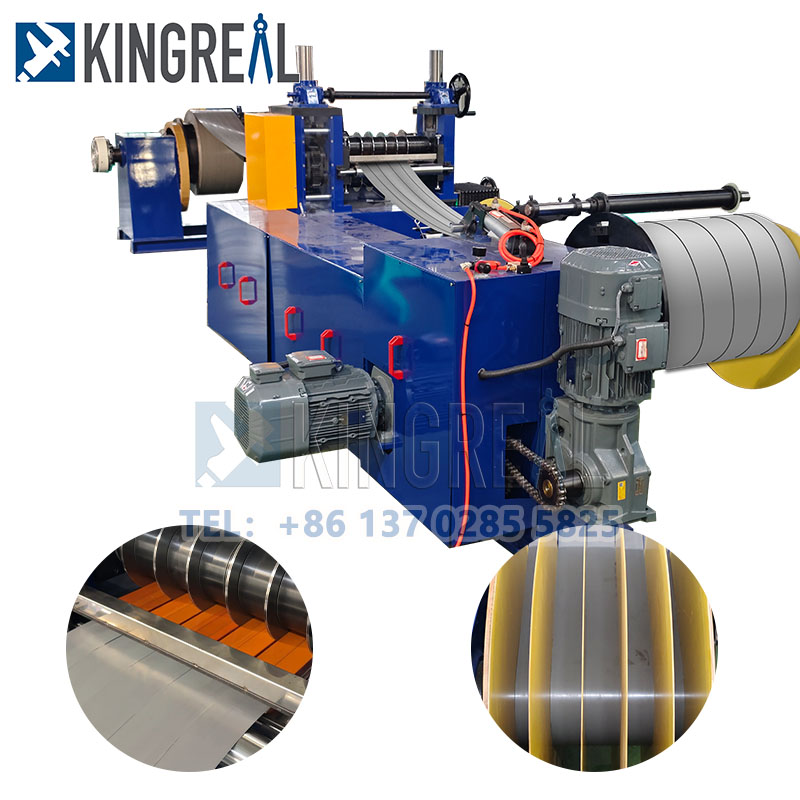
Core Function of Single Loop Design in Simply Slitting Lines
Many people believe that simply slitting lines operate at low speeds and do not require a loop buffer structure. However, in actual production, even in low-speed operation, after the sheet metal is slit by the disc shear, the multiple narrow strips will still exhibit slight length and output speed differences. Over time, this can severely impact the quality of the finished product. Based on this production pain point, equipping simple coil slitting machines with a rear-mounted single loop structure is the optimal solution that balances production costs and quality. It effectively achieves speed synchronization and tension buffering between the slitter and the recoiler, comprehensively optimizing the production stability of the simply slitting line.
1) The back loop bridge in the simple coil slitting machine effectively balances the output deviations of multiple narrow strips, resolving winding quality defects. During slitting operations, multiple narrow strips of sheet metal are output simultaneously. Due to factors such as minor wear of the cutting tools, variations in sheet thickness uniformity, and minor errors in mechanical transmission, the output speed of each strip cannot be completely consistent.
2) Utilizing the drop buffer space of the back loop bridge faster-moving strips can naturally drop and be stored, while slower-moving strips are conveyed normally, completely offsetting the speed difference between multiple strips. This fundamentally avoids quality problems such as uneven winding tension, uneven end faces of the roll, and localized bulges, significantly improving the finished product qualification rate of the simply slitting line.
The loop structure of the simple coil slitting machine can buffer tension fluctuations, preventing sheet damage and strip breakage. During the expansion and contraction start-up, shutdown, and speed fine-tuning of the simply slitting line's winding mechanism, instantaneous tension fluctuations occur, directly pulling on the sheet surface. The back loop bridge can buffer instantaneous tension impacts through dynamic adjustment of material storage and release. This avoids sheet stretching deformation, surface scratches, and defects caused by excessive tension, and also eliminates strip breakage caused by sudden tension changes, effectively reducing the probability of production failures and minimizing sheet waste.
3) The single loop structure of the simple coil slitting machine greatly simplifies the manual operation process and is compatible with the equipment's minimalist operating characteristics. In situations such as threading, material changing, and temporary shutdowns followed by restarts on the production line, the material storage buffer space of the loop can offset the short-term speed difference between upstream and downstream processes. This eliminates the need for precise manual matching of the start-up and shutdown rhythms of each piece of equipment, reducing the operational difficulty of threading alignment and material changing adjustments, shortening equipment downtime for debugging, and comprehensively improving the operational convenience of the simply slitting line.
Core Reason Why Simply Slitting Lines Do Not Have a Front Loop?
Typically, simple coil slitting machines adopt a configuration without a front loop, with an optional back single loop. This is the optimal professional choice considering the operating parameters, equipment configuration, cost positioning, and characteristics of the processed materials.
1) Low operating speed eliminates the need for a front loop buffer.
The typical operating speed of a simply slitting line is only 20-40 m/min, far lower than that of high-end fully automatic slitting machines. At low speeds, the speed difference between the decoiler and the slitter is minimal. Slight speed asynchrony will not cause stretching, waviness, or wrinkling of the sheet metal, resulting in a very low risk of sheet deformation. Therefore, a front loop for material storage and speed adjustment buffering is completely unnecessary.
2) The equipment configuration is rudimentary, requiring no continuous material storage for production.
Simple coil slitting machines emphasize lightweight and simplified configurations, mostly paired with ordinary single-head decoilers, lacking fully automatic joint cutting and automatic roll changing functions. During raw material roll changing and sheet joint processing, the simply slitting line will stop directly, making continuous production without shutdown impossible. The material storage and production continuation function of the front loop is completely useless and requires no additional configuration.
3) Controlling costs and land area aligns with the core positioning of simple coil slitting machines.
The core advantages of simply slitting lines are low cost, small footprint, and low setup costs. Adding a front loop requires additional excavation of the looper pit, construction of a steel structure support platform, and the addition of auxiliary facilities such as liquid level detection, photoelectric sensors, and safety railings, significantly increasing civil engineering and equipment costs, and occupying more workshop space, completely contradicting the low-cost and lightweight design principles of simple coil slitting machines.
4) Strong adaptability to incoming sheet materials and high tolerance for errors.
The simply slitting line primarily processes conventional sheet metal such as ordinary cold-rolled steel and galvanized steel. These materials possess good toughness and strong tensile strength, exhibiting extremely high tolerance for minor stretching and shape deviations caused by slight speed discrepancies. Minor deformations will not affect downstream processing, eliminating the need for a pre-installed looper to optimize sheet shape.
KINGREAL SLITTING does not offer standard simple coil slitting machines, adhering to a customized service model. Our team will consider the client's specific project needs, including the type of sheet metal being processed, sheet thickness, slitting width, production speed, site dimensions, and budget, to design a tailored loop configuration, equipment structure, and supporting systems. This creates a highly adaptable and cost-effective customized simply slitting line for each client.
For more information on simple coil slitting machine configuration details and customization options, please contact KINGREAL SLITTING directly to obtain a personalized and precise customized solution.