In the modern metal processing industry, the delivery of high-precision metal sheets serves as the foundation for subsequent operations such as stamping, laser cutting, or welding. However, many facilities find that even brand-new metal cut to length lines may experience a decline in precision after a period of operation.
Common quality issues include length tolerances exceeding standards, significant burrs along the edges, and the development of warping or waviness in the sheets after cutting. Such issues not only lead to the waste of raw materials but also directly disrupt the schedules of downstream automated production lines. As a professional manufacturer of metal cut to length machines with extensive experience in R&D and production, KINGREAL SLITTING asserts that the precision of a metal cut to length line is the result of the synergistic interaction between four key components: leveling, cutting, rigid drive systems, and control systems.
Below, we provide an in-depth diagnosis of the underlying factors affecting the precision of these metal cut to length machines, categorized into four core dimensions.
Diagnosis 1: Leveler for Metal Cut to Length Line
1. 4-Hi Leveling Configuration
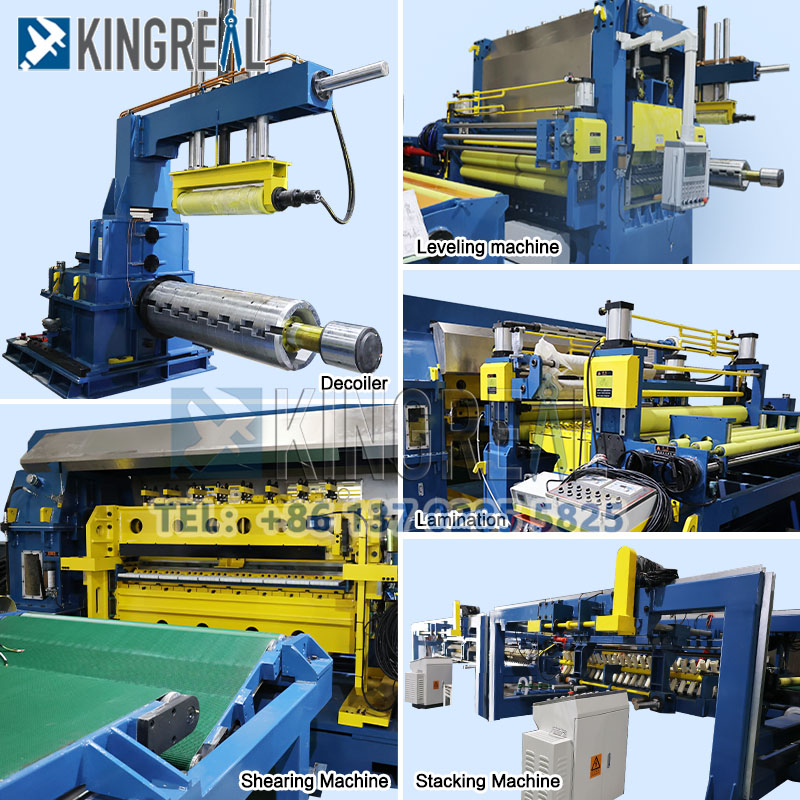
This configuration consists of upper and lower rows of leveling rollers, supported by corresponding backup rollers. It is suitable for standard hot-rolled sheets or low-carbon steel, where surface quality requirements are moderate. Its primary function is to eliminate basic wavy deformations through a staggered roller arrangement.
2. 6-Hi Leveling Configuration
For materials highly sensitive to surface finish and internal stress—such as stainless steel, aluminum, or high-strength steel—KINGREAL SLITTING recommends a 6-Hi leveling system.
Compared to the 4-Hi configuration, the 6-Hi setup incorporates intermediate rollers positioned between the leveling rollers and the backup rollers. These intermediate rollers prevent the leveling rollers from undergoing minor deflection under pressure, ensuring exceptional flatness across both the transverse and longitudinal directions—a prerequisite for achieving high-precision cutting in a metal cut to length machine.
3. Double Leveler Configuration
For metal cut to length lines with exceptionally high performance requirements, a dual-leveler setup may be employed. Materials processed through these two stages exhibit stabilized internal stress, ensuring highly precise physical dimensions after shearing.
Diagnosis 2: Shear Blades and Shearing Systems for Metal Cut to Length Lines
1. Blade Material and Heat Treatment
High-quality metal cut to length machines typically utilize Cr12MoV, SKD11, or even more advanced alloy tool steels. Following rigorous vacuum quenching and cryogenic treatment, these materials achieve a hardness exceeding HRC60, offering exceptional wear resistance.
If the material quality is substandard, the blades will dull prematurely, increasing cutting resistance and causing tearing or burrs along the sheet edges.
2. Dynamic Blade Gap Adjustment
The optimal blade gap varies according to the thickness of the metal sheet. An excessive gap leads to edge collapse and burrs, while an insufficient gap can damage the cutting edges and cause work-hardening of the sheet edges due to excessive heat.
KINGREAL SLITTING metal cut to length lines feature an automated, PLC-controlled gap adjustment system; based on the input sheet thickness, the system automatically drives the adjustment mechanism to maintain the gap within a micron-level tolerance.
Diagnosis 3: Equipment Rigidity and Transmission Precision for Metal Cut to Length Lines
1. Heavy-Duty Welded Frames and Annealing
Welding processes generate significant internal stress within the frames of metal cut to length machines. If machined without further treatment, the frames may undergo minor physical deformation over time.
All heavy-duty frames used in KINGREAL SLITTING metal cut to length lines undergo high-temperature annealing to completely eliminate internal metal stress. This ensures the frames remain free from deformation for over a decade of operation, thereby maintaining the geometric precision of the leveling rollers and shear blade assemblies.
2. High-Precision Gear Reducers and Transmission Systems
For power transmission, high-precision planetary gear reducers and zero-backlash couplings are standard. The transmission system must ensure that no fluctuations or play (backlash) occur during frequent acceleration and deceleration cycles.
3. Anti-Slip Feeding Design
For metal cut to length machines, KINGREAL SLITTING utilizes a special PU coating or a micro-textured finish on the surfaces of the feed rollers. This design significantly increases friction between the rollers and the metal sheet, ensuring the material remains firmly under control—without any shifting or drifting—even during high-speed operation or frequent braking.
Diagnostic 4: Positioning and Control Systems for Metal Cut to Length Lines
1. Full Servo Drive
The metal cut to length line employs a full servo drive system, enabling exceptionally high dynamic response speeds. Driven by high-frequency pulse commands, the servo motors precisely control every rotation and degree of the feed rollers, ensuring displacement accuracy down to the micron level.
2. Closed-Loop Control System
By integrating high-resolution encoders at the end of the metal cut to length machine, the closed-loop control system provides real-time feedback on the actual displacement of the metal sheet to the PLC.
If a deviation—even as small as 0.05 mm—is detected between the actual position and the programmed command, the system applies algorithmic compensation within microseconds, correcting the error before the next sheet is cut.
3. Independent Measuring Roller
KINGREAL SLITTING incorporates a measuring roller that operates independently of the drive rollers. Pressed lightly against the surface of the metal sheet by a pneumatic cylinder, this roller rotates solely in response to the movement of the sheet and bears no load related to power transmission. This design eliminates any interference in length measurement that might otherwise be caused by drive roller slippage, oil contamination, or fluctuations during acceleration and deceleration.
An exceptional metal cut to length line does more than simply cut metal coils; it serves as the critical first step in precision manufacturing, delivering high-quality blanks ready for subsequent, high-standard production processes.
From the elimination of internal stresses and the control of dynamic shearing gaps to maintaining the rigidity of the machine frame and utilizing real-time compensation via a closed-loop system—every single aspect determines the final level of precision.
Are you looking for a high-precision metal cut to length machine? Contact KINGREAL SLITTING today for expert technical support and a competitive quote on a premium metal cut to length line!