HR slitting is a core pre-processing step in steel processing. Its core function is to precisely slit wide, thick hot-rolled steel coils into multiple narrow strips with uniform precision using a hr slitting machine. Hot-rolled strips processed by this hot rolled steel slitting line retain the steel's excellent basic properties and offer advantages such as ease of sawing, drilling, strong adaptability to laser cutting, good forming effect, and stable welding performance. They can also undergo various industrial coating treatments, adapting to diverse processing needs. Therefore, HR slitting, achieved through a hr slitting machine, is widely used in industries such as construction steel, automotive steel, hardware processing, pipe manufacturing, and construction machinery.
In hot-rolled deep-processing production lines, the hot rolled steel slitting line determines the slitting accuracy, finished product surface quality, cut smoothness, and overall production efficiency. KINGREAL SLITTING, as a professional R&D, manufacturing, and supplier of hr slitting machines, will comprehensively analyze the fundamental characteristics, complete process flow, equipment differentiation advantages, and key procurement points of HR slitting.
Basic Definition of HR Slitting Process
1. Core Differences Between HR and CR Slitting
Although both HR and CR slitting belong to the longitudinal slitting process of steel, their processing objects, production difficulty, and equipment requirements differ greatly. The core differences lie in two dimensions: raw materials and processing difficulty. Furthermore, their compatibility requirements for metal slitting machines are drastically different; a dedicated hot rolled steel slitting line is necessary to ensure production quality.
Differences in Raw Materials:
HR slitting uses hot-rolled steel coils. These coils have higher hardness and extremely high toughness, with a dense oxide layer on the surface, and a wide thickness range, covering various thin, medium, and thick steel materials. The tolerance for errors in raw material processing is low. In contrast, cold-rolled slitting uses cold-rolled steel coils. After CR finishing, the surface is smooth and flat, the material texture is uniform, the thickness is thin, and the specifications are consistent. The raw material has a higher basic quality, and the processing difficulty is lower.
Differences in Processing Difficulty:
HR slitting is a typical heavy-duty shearing operation. The characteristics of thick materials, high hardness, and oxide scale place extremely high demands on the overall rigidity of the hr slitting machine, the wear resistance of the cutting tools, the load-bearing capacity of the equipment, and the shearing power, far exceeding those of ordinary CR slitting machines. CR slitting primarily involves light-duty precision shearing, focusing on fine-tuning of dimensional accuracy. It does not require heavy-duty load-bearing capacity, and its overall structure and cutting tool configuration are relatively simple, making it unsuitable for processing thick hot-rolled materials.
2. Application of HR Slitting Technology
Leveraging the strong adaptability, high load-bearing capacity, and heavy-duty shearing advantages of hot rolled steel slitting lines, the HR slitting process can process various high-hardness, thick-gauge metal coils. Applicable materials include hot-rolled carbon steel, low-alloy steel, pickled hot-rolled coils, wear-resistant steel coils, and other commonly used thick industrial steels, covering most heavy industrial steel processing needs.
With its stable processing quality, the narrow strips slit by the hr slitting machine are mainly used in core fields such as steel structure component processing, industrial welded pipe raw material preparation, automotive chassis load-bearing component production, hardware precision stamping, and engineering machinery structural component manufacturing. It is an indispensable pre-process for heavy industrial steel forming and deep processing, providing standardized raw materials for subsequent precision processing, forming, and assembly processes.
Complete HR Slitting Process
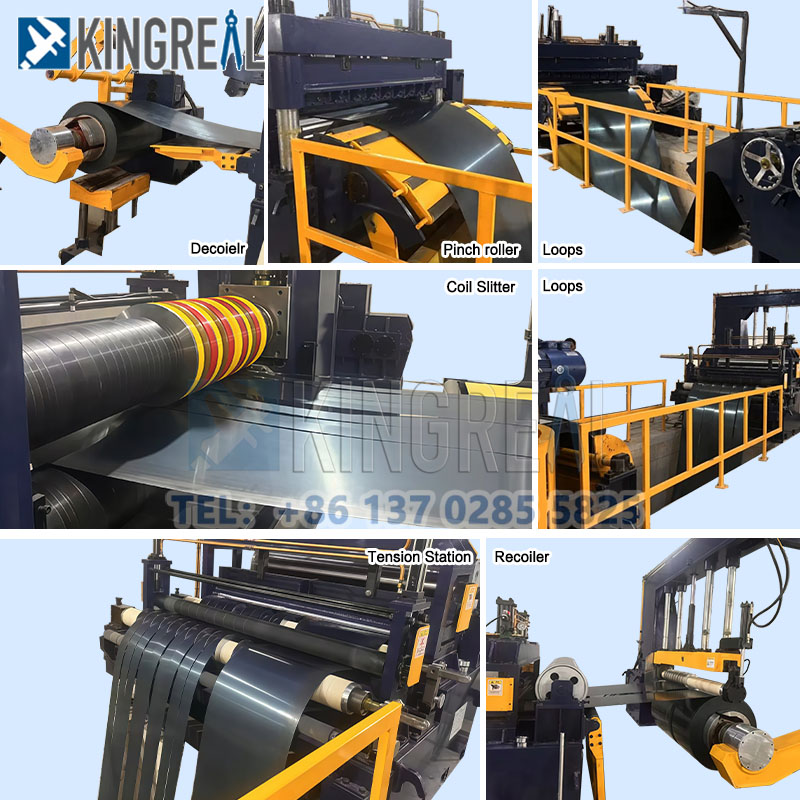
Uncoiling: The decoiler smoothly and uniformly unfolds the heavy HR steel coil, eliminating the coil winding tension and providing a flat and stable feeding base for subsequent leveling and slitting processes.
Leveling: The unfolded thick steel plate automatically enters the leveling unit, where repeated rolling and straightening by multiple sets of high-precision leveling rollers completely eliminates the natural bending, wave deformation, and internal stress generated during the rolling and coiling process of the hot-rolled steel coil. This process ensures the flatness of the plate, making the plate entering the hot rolled steel slitting line uniform in state.
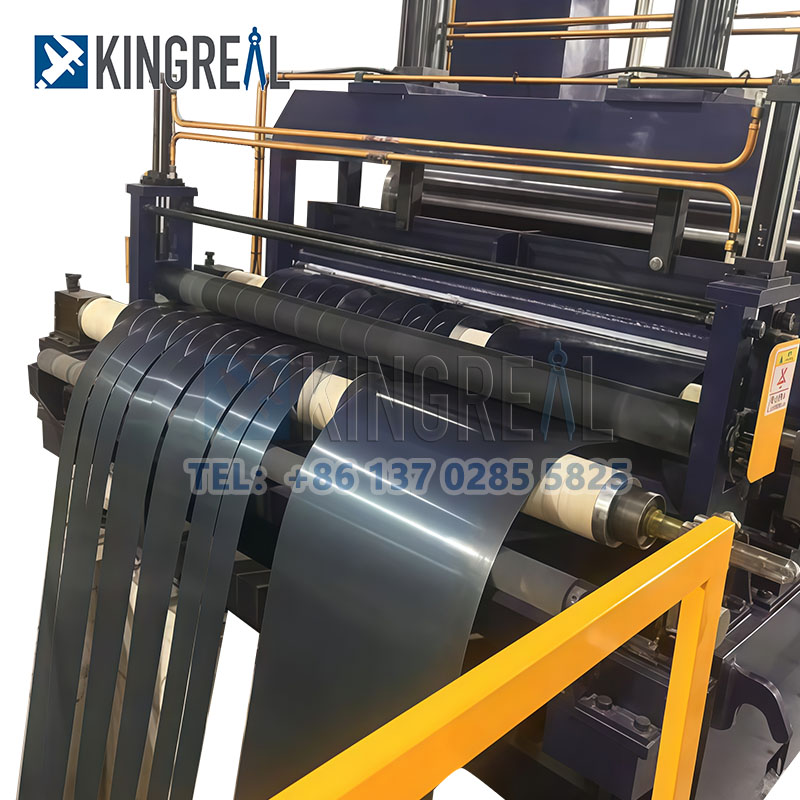
Slitting: The leveled continuous steel plate is fed uniformly into the slitter. The equipment is equipped with a high-precision circular rotating blade assembly that uniformly cuts the wide hot-rolled steel sheet from the edge to the entire surface according to preset processing width parameters, slicing it into multiple narrow strips of precise width and with flat cut surfaces in a single operation.
Tensioning: After slitting, the multiple narrow steel strips enter the precision tensioning mechanism. The equipment uses an intelligent tension control system to adjust the steel strip tension in real time, precisely correcting any misalignment and completely eliminating problems such as steel strip stretching, deviation, wrinkling, and misalignment.
Rewinding: The recoiler rewinds the narrow strips in an orderly and uniform manner, forming steel strip coils of uniform specifications that are easy to transport and further process.
Ordinary Metal Slitting Machine vs. HR Slitting Machine
Many manufacturers easily confuse ordinary metal slitting machines with specialized hot rolled steel slitting lines. The core structures, performance parameters, and applicable scenarios of these two types of equipment differ significantly. Ordinary metal slitting machines cannot replace hr slitting machines for processing thick hot-rolled materials. The specific differences are reflected in three aspects:
- Load-bearing capacity and rigidity comparison: Ordinary metal slitting machines use a thin frame structure, resulting in insufficient overall rigidity and weak load-bearing capacity. They are only suitable for shearing thin cold-rolled materials and ordinary thin materials. When faced with heavy-load shearing conditions involving large hot-rolled coils and thick plates, they are prone to frame deformation, equipment vibration, and positioning deviations, making stable production impossible. In contrast, specialized hot rolled steel slitting lines use a thickened and reinforced one-piece molded frame, which undergoes annealing treatment to enhance structural stability. This significantly improves load-bearing capacity and resistance to deformation, allowing for long-term heavy-load processing of large coils and thick hot-rolled steel.
- Tool Compatibility Comparison: Standard metal slitting machines are equipped with tools that have limited hardness and wear resistance. When processing hot-rolled raw materials with oxide scale and high hardness, they are prone to rapid tool wear, edge chipping, and shearing jamming, resulting in rough, burred, and highly defective finished products. HR slitting machines, on the other hand, are equipped with customized, high-hardness, wear-resistant tools specifically designed for the oxide scale and high hardness characteristics of hot-rolled steel. This ensures a smooth and stable shearing process, producing a smooth, burr-free, and scratch-free steel strip.
- Stability Comparison: Standard metal slitting machines lack dedicated tension and correction systems. When processing thick hot-rolled materials, the high hardness and tension of the steel easily lead to strip deviation, overstretching, surface wrinkles, and uneven slitting width, resulting in extremely poor production stability. Professional hot rolled steel slitting lines are equipped with a precision intelligent tension control system and a fully automatic correction device, calibrating the plate position and tension in real time throughout the process.
Key Points for Purchasing a HR Slitting Machine
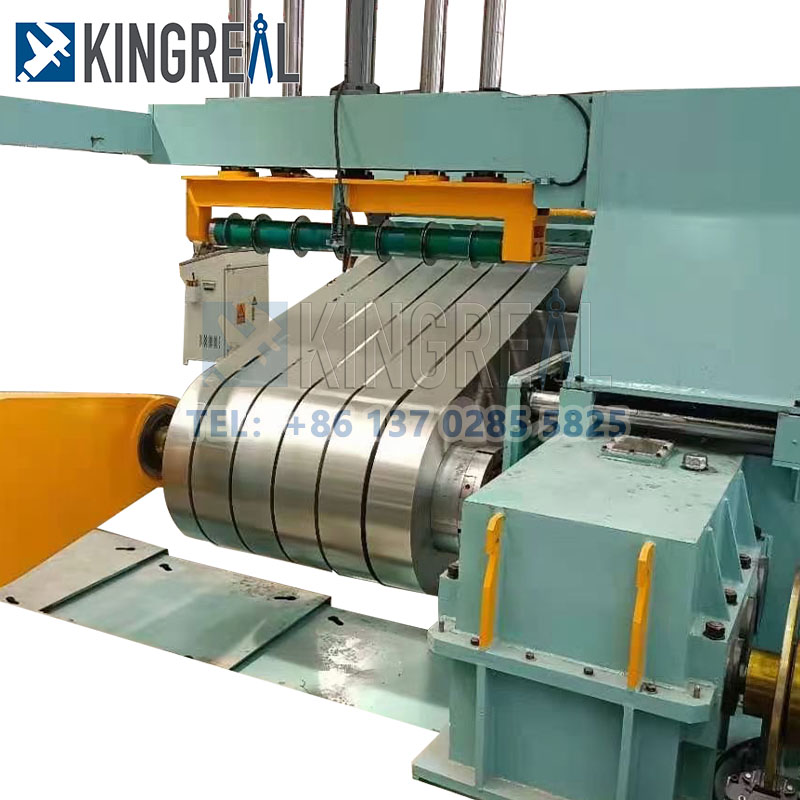
First, match the hot rolled steel slitting line parameters to your needs. Based on the maximum thickness, maximum weight, and slitting width accuracy standards of the hot-rolled coils typically processed by the enterprise, the overall load-bearing capacity, shearing power, cutter shaft accuracy, and cutter configuration of the hr slitting machine should be matched accordingly.
Secondly, high-end configuration models should be prioritized. During procurement, focus should be placed on the core configuration of the hot rolled steel slitting line, prioritizing professional equipment with an integral annealing frame, a fully hydraulic drive mode, and a CNC intelligent control system.
Finally, the overall performance and after-sales service of the equipment should be comprehensively considered. The wear resistance of the cutters, the fatigue resistance of the entire machine, and the degree of automation should be carefully checked. Attention should also be paid to the manufacturer's after-sales commissioning, equipment maintenance, and customization capabilities to ensure that the equipment can adapt to the diverse and personalized steel processing scenarios of the enterprise.
KINGREAL SLITTING specializes in the research and development and production of various customized hr slitting machines, which can accurately adapt to hot-rolled steel processing scenarios with different thicknesses, materials, and precision requirements. We provide one-stop hot rolled steel slitting line customization, installation, commissioning, and after-sales maintenance services to comprehensively meet the HR slitting production needs of various enterprises.