In metal processing, the standardized packaging of finished steel coils is a critical step in ensuring quality during storage, transportation, and export.
Currently, two types of systems are widely used: the vertical steel coil packing line and the horizontal steel coil packing line.
These steel coil packaging lines automate the entire packaging process—including film application, wrapping, and strapping—replacing manual labor.
The fundamental difference between the vertical steel coil packing line and horizontal steel coil packing line lies in the orientation of the steel coil and the method of conveyance during the packaging process.
This distinction directly influences their performance regarding floor space requirements, compatible specifications, automation levels, investment costs, and suitable application scenarios.
In this article, KINGREAL SLITTING provides a detailed analysis of the working principles, key advantages, and applications for both vertical steel coil packing line and horizontal steel coil packing line.
This information aims to help you select the optimal packaging solution—capable of withstanding high-intensity, rigorous production environments—based on your specific operational needs.
Types of Steel Coil Packaging Line
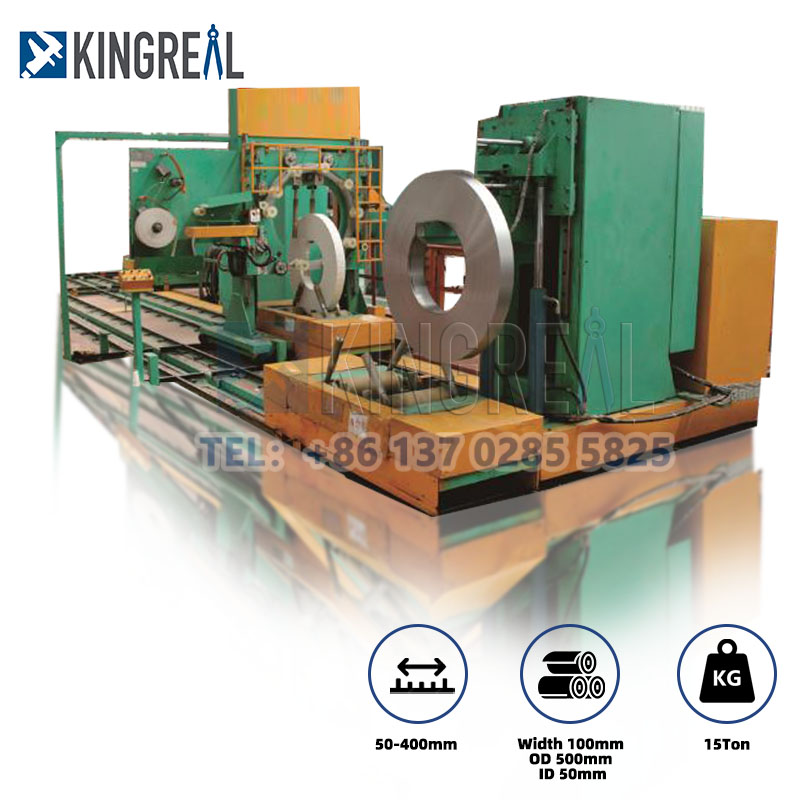
What is a Vertical Steel Coil Packing Line?
The vertical steel coil packing line is designed for "eye-to-sky" packaging operations, where the steel coil remains upright (with its end face facing upward) throughout the entire packaging process.
The vertical steel coil packing line relies on a fixed packaging station and rotates the coil itself to perform wrapping and strapping tasks. Its compact structure makes it ideal for the standardized packaging of heavy steel coils.
Workflow of Vertical Steel Coil Packing Line:
Coil loading → Automatic centering and alignment → Manual or automated placement of bottom pads and edge protectors → Coil rotation around its central axis for fully automated film application and wrapping → Precise placement and securing of the top cover plate → Reinforcement via circumferential and radial strapping → Automatic unloading and transfer of the finished coil.
Throughout the process, the main packaging equipment remains largely stationary, requiring only minor linear adjustments.
Packaging is achieved through the uniform rotation of the coil, ensuring comprehensive coverage without blind spots and resulting in excellent sealing and structural integrity.
What is a Horizontal Steel Coil Packing Line?
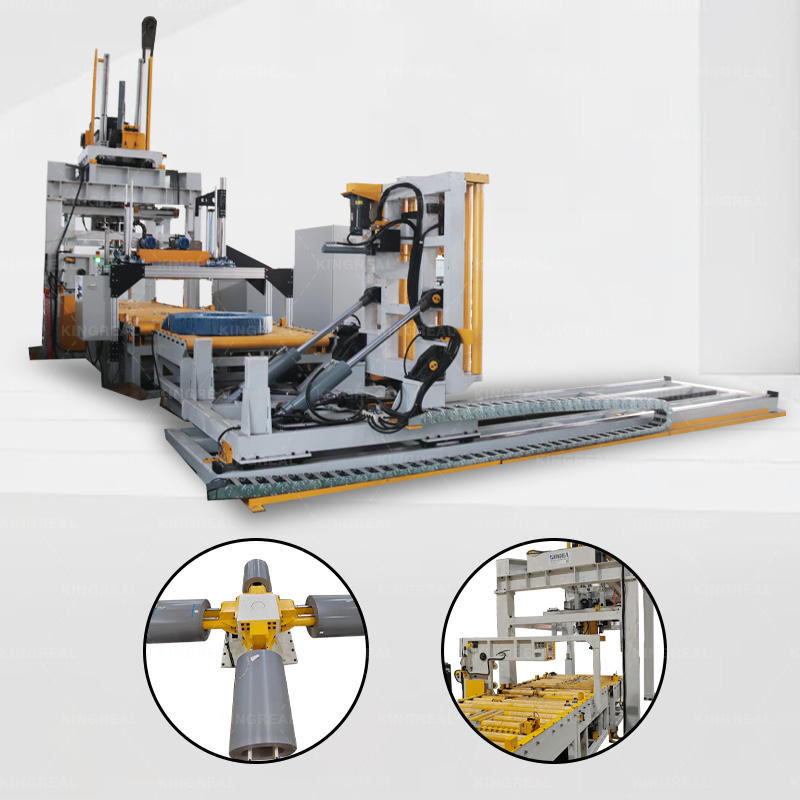
The horizontal steel coil packing line is designed for "eye-to-wall" packaging scenarios. The steel coil remains lying flat on a conveyor roller bed throughout the process, moving sequentially through various packaging stations with its axis positioned horizontally.
As a continuous, assembly-line-style packaging system, it is widely used at the end of large-scale, continuous steel coil production lines.
Workflow of Horizontal Steel Coil Packing Line:
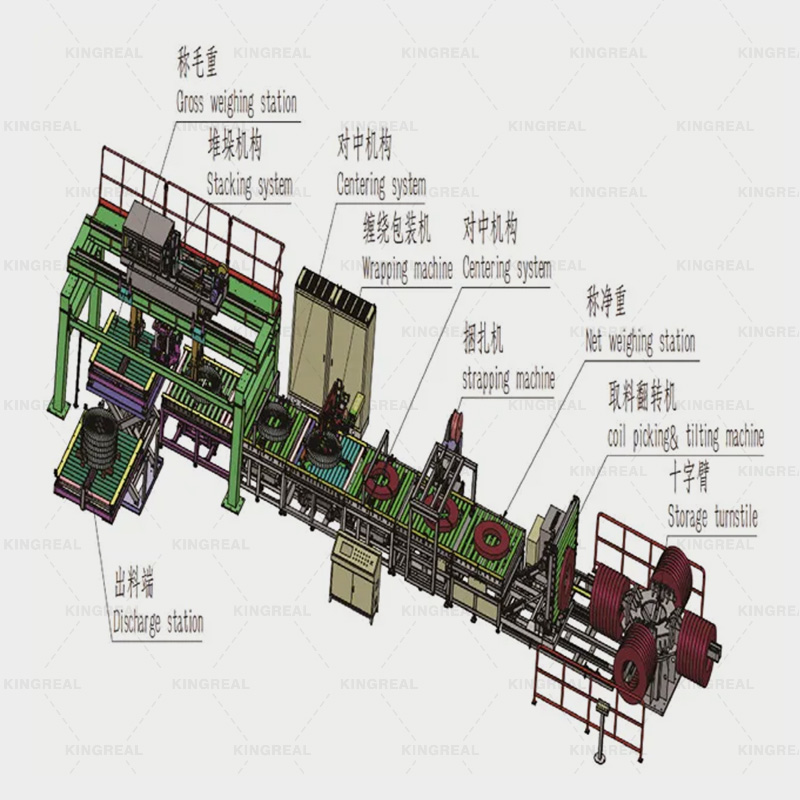
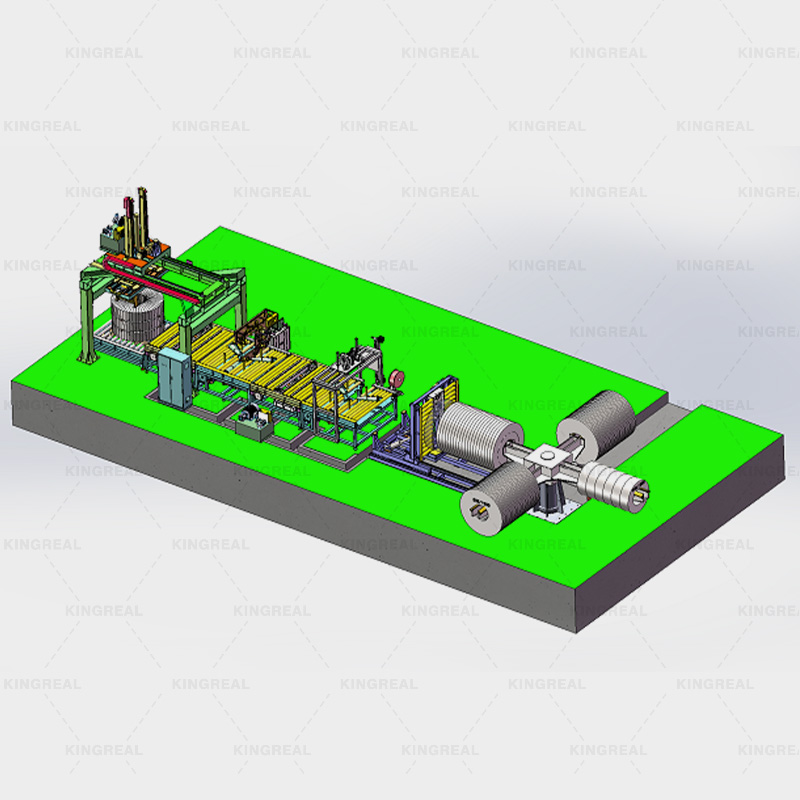
Coil loading → Constant-speed linear transport via roller bed → Automatic entry into bagging and wrapping stations for outer protective packaging → Transport to a gantry-style strapping station for multiple reinforcement straps → Continuous transport of finished coils to the stacking area for storage.
Unlike vertical steel coil packing lines, the core operational logic of the horizontal steel coil packing line involves the linear movement of the coil.
All packaging stations are arranged linearly along the line and operate in coordination, enabling uninterrupted batch packaging production.
Key Differences Between Vertical and Horizontal Steel Coil Packing Line
Regarding coil orientation: The vertical steel coil packing line keeps the coil's end face upright throughout the process, with the central eye perpendicular to the ground; the horizontal steel coil packing line positions the coil with its axis horizontal, keeping the central eye parallel to the ground.
Regarding core movement: The vertical steel coil packing line relies on the coil rotating around its own central axis to complete packaging, resulting in minimal equipment movement; the horizontal steel coil packing line centers on linear transport, completing packaging steps as the coil moves between stations.
Regarding the operational process: The vertical steel coil packing line follows a closed-loop process of "precise positioning → integrated rotating packaging → single-coil discharge," offering higher precision per coil; the horizontal steel coil packing line employs a "continuous transport → multi-station step-by-step packaging → batch transfer" model, offering greater production continuity.
Regarding spatial layout: The vertical steel coil packing line has specific requirements for vertical factory height but occupies a smaller footprint, ensuring high space utilization; the horizontal steel coil packing line does not require significant ceiling height but demands a long linear layout, occupying more floor space.
Regarding automation focus, the vertical steel coil packing line prioritizes automating the vertical loading and unloading of coils, making it suitable for heavy-duty material handling; the horizontal steel coil packing line focuses on the coordinated automation of the conveying system and various packaging stations to ensure a continuous production rhythm.
How to Choose Between Vertical and Horizontal Steel Coil Packing Line?
1. Selection based on coil weight and dimensions
The vertical steel coil packing line boasts exceptional load-bearing capacity; its rotating platform features a robust and stable structure capable of handling heavy coils weighing tens or even hundreds of tons, making it the preferred choice for heavy-duty coil packaging.
However, due to its central rotation operating mode, the vertical steel coil packing line requires consistent coil inner diameters. If a factory handles a wide variety of inner diameter specifications, the need to change expansion mandrels or adapters increases changeover time and complicates equipment maintenance.
Additionally, since the coil width determines the operating height in vertical packaging, excessively wide coils raise the equipment's vertical clearance requirements and increase the vertical drape of packaging materials, which can compromise packaging smoothness.
The horizontal steel coil packing line distributes the coil's weight across roller conveyors, eliminating the bending stresses associated with lifting coils into a vertical position.
It offers significant advantages in supporting and transporting extra-long or extra-wide coils, effectively preventing deformation or structural damage.
This horizontal steel coil packing line is highly compatible with varying outer diameters, allowing coils of different sizes to share the same production line without frequent changeovers.
Furthermore, the gantry-style strapping and wrapping equipment on the horizontal line can be customized according to coil width; unconstrained by vertical space limitations, it easily accommodates packaging operations for various extra-wide silicon steel and color-coated steel coils.
2. Selection based on production applications
The vertical steel coil packing line is suited for specific high-end, heavy-duty packaging scenarios.
It is primarily used for packaging extra-thick plate coils destined for heavy machinery and pressure vessels, as well as for processing coils intended for maritime export.
Its dual strapping mode—applying straps both radially and circumferentially—significantly enhances strapping strength, effectively preventing interlayer slippage or loosening during ocean transport.
Furthermore, for workshops characterized by moderate production pacing, heavy coil weights, and standardized inner diameters, a vertical steel coil packing line can significantly enhance packaging stability and the pass rate of finished products.
A horizontal steel coil packing line is better suited for large-scale production environments requiring high throughput and superior surface quality.
For steel coils with stringent surface finish requirements—such as silicon steel, galvanized sheet, and color-coated sheet—using a horizontal steel coil packing line minimizes surface scratches and abrasion.
For materials prone to impact damage, such as stainless steel coils, the horizontal packaging method avoids edge damage that can occur during the processes of upending or rotating the coils.
Additionally, the horizontal steel coil packing line integrates seamlessly with the end of continuous production lines, accommodating high-frequency operations and frequent specification changes to facilitate efficient mass production.
To learn more about customized solutions, equipment specifications, and implementation costs for these two automated steel coil packaging lines, please contact the professional team at KINGREAL SLITTING for a comprehensive, one-stop automated steel coil packaging solution.