In the modern metal processing industry, high-efficiency steel slitting machines can produce dozens of narrow metal strips in just minutes. However, the real challenge often arises after slitting: the manual handling, strapping, and stacking of these heavy, sharp-edged coils create production bottlenecks and increase the risk of coil damage and personnel injury.
This is where the steel coil packing line becomes indispensable. By seamlessly connecting to the steel slitting machine's exit, the automated slit coil packing line transforms the slit coils into protected, stacked, and ready-to-ship finished products.
What is a Steel Coil Packing Line?
A steel coil packing line is a highly automated system connected directly to the steel slitting machine. Its core function is to continuously buffer, reorient, protectively wrap, and palletize the coils produced by the steel slitting machine.
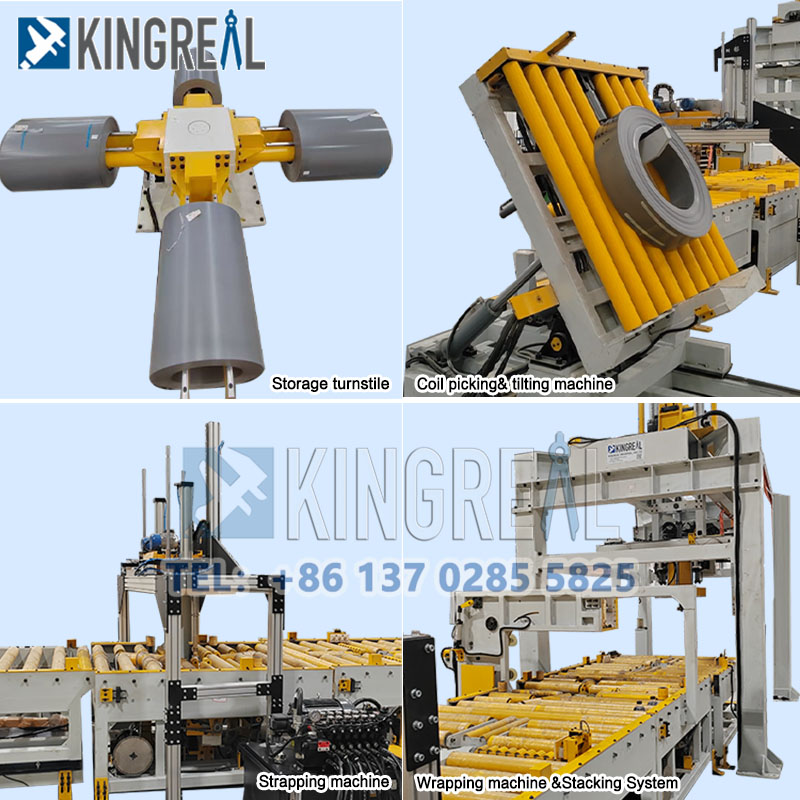
A typical slit coil packing line consists of the following precision modules:
Coil tilting: Handles orientation changes.
Coil strapping: Performs multi-pass reinforcement.
Coil wrapping: Provides surface protection.
Automatic stacking: Completes final palletizing and warehousing
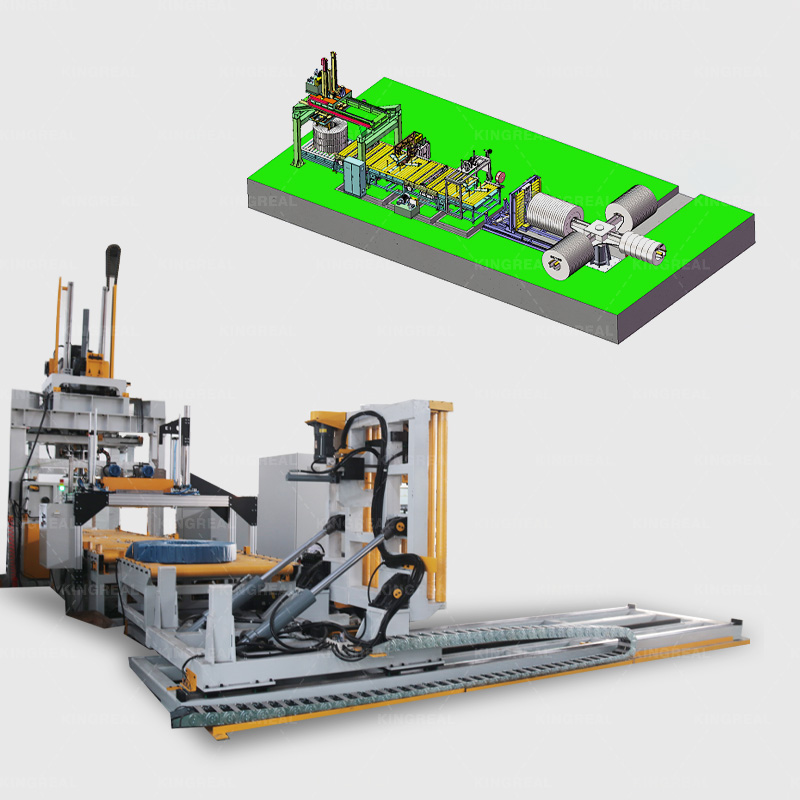
Workflow of Slit Coil Packing Line
Step 1: Retrieval and Reorientation
Once the narrow metal strips are slit and recoiled, they hang on a cross-type turnstile coil-storage arm. The retrieval and downending unit automatically separates and grips individual coils.
Core Logic: The machine flips the coil from a vertical orientation ("Eye-to-Wall") to a horizontal orientation ("Eye-to-Sky").
Coil Protection: The mechanism supports the load throughout the flipping process; the coil never touches the ground or requires overhead lifting, completely eliminating damage to coil edges or surface dents caused by lifting hooks.
Step 2: Automatic Weighing (Optional)
The coil enters the weighing station, where high-precision sensors automatically capture net weight data.
Digital Integration: Data is automatically uploaded to the PLC control system and linked to batch records, replacing manual logging and providing accurate parameters for subsequent labeling.
Step 3: Automatic Strapping
The automatic strapping machine secures the slit coil with PP or PET straps according to a preset number of passes (typically 3–4).
Tension Control: Strapping tension is uniform and adjustable; this ensures the coil remains tight and free of layer shifting during long-distance transport, while preventing indentation marks on the edges of sensitive materials.
Step 4: Intelligent Labeling (Optional)
A print-and-apply labeling machine automatically generates labels based on real-time weighing data. Labels contain information such as coil number, grade, specifications, net weight, and batch number; they are applied to the inner or outer circumference, supporting full-process traceability via QR codes or barcodes.
Step 5: Stretch Wrapping and Wooden Strip Application
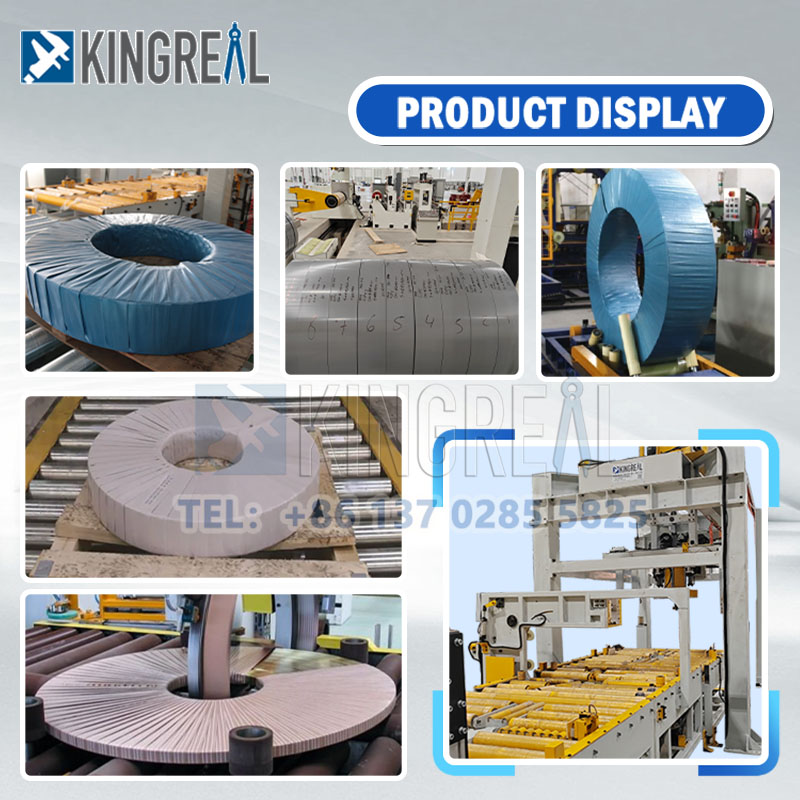
The stretch wrapping machine wraps the coil circumferentially through its center bore, using materials such as stretch film, woven strapping, or composite paper.
Functional Objective: Provides a seal that protects against moisture, dust, and oxidation.
End-Face Protection: In high-end configurations, a wooden strip applicator automatically attaches protective wooden strips to the coil's end face, further enhancing structural protection during stacking.
Step 6: Automatic Stacking and Palletizing
Finally, a stacker uses suction cups or mechanical grippers to place finished coils onto wooden pallets according to a preset stacking pattern. Once the stack is complete, the conveyor line transports it to the forklift unloading area for warehousing.
Key Advantages of Steel Coil Packaging Line
●Significantly Increased Throughput: The packaging cycle is precisely matched to the output pace of the steel slitting machine. Eliminating packaging bottlenecks allows the overall production capacity of the entire line to increase by more than 30%.
●Consistent Quality and Zero Damage: Manual lifting is the primary cause of edge deformation in steel coils. The automated steel coil packing line ensures the coil receives mechanical support throughout the process, fully meeting the acceptance standards of high-end industry clients in sectors like automotive and electronics.
●Comprehensive Data Traceability: Automatic weighing and labeling create a digital twin for each coil, resulting in clearer warehouse management and completely eliminating the risk of shipping the wrong batch.
●Significantly reduce labor costs: A fully automated slit coil packing line typically requires only one inspector, whereas traditional manual packaging demands a team of 4–6 workers. This not only cuts wage expenses but also mitigates safety risks associated with handling heavy steel coils.
●Flexible and efficient product changeovers: Modern systems support one-touch changeovers. By simply switching recipes via the HMI, the system can adapt within seconds to handle slit coils of varying widths, diameters, and weights.
The efficiency ceiling of a steel slitting machine is largely determined by the downstream slit coil packing line. KINGREAL SLITTING offers seamless integration between steel slitting machines and steel coil packing lines, ensuring a highly efficient, closed-loop production process—from raw material slitting to finished product warehousing.
As a leader in coil processing technology, KINGREAL SLITTING can tailor automated packaging solutions to your specific material characteristics and factory layout.
Looking to Optimize Your Post-Slitting Processing Workflow?
Consult KINGREAL SLITTING technical experts to receive a customized slit coil packing line solution and an ROI analysis report!