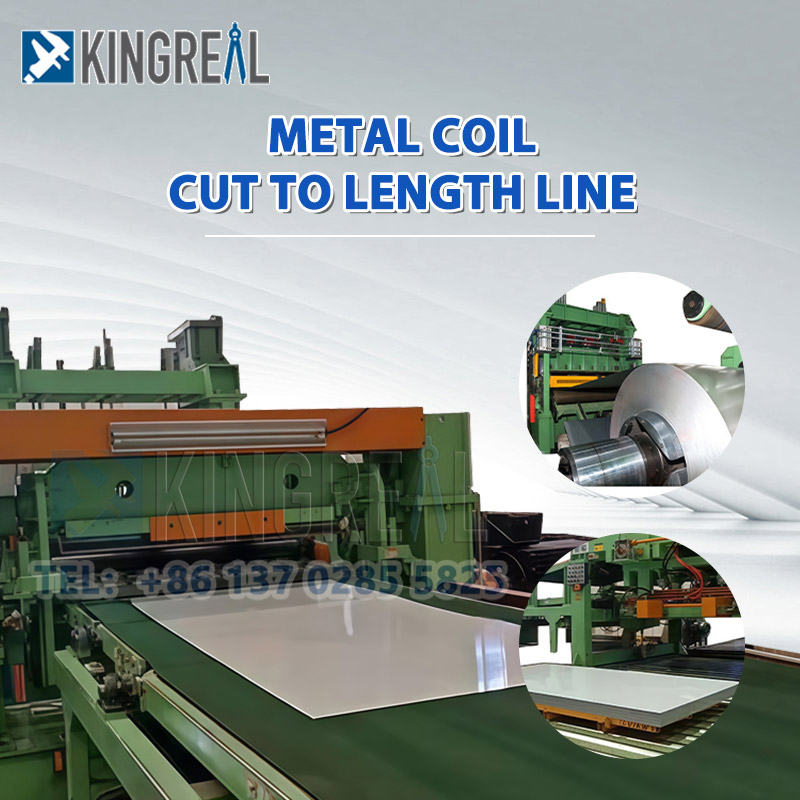
In the modern metal processing industry, production efficiency and machining precision are core indicators of a company's competitiveness. metal sheet processing methods have evolved from manual shearing to semi-automated equipment assistance, and finally to today's fully automated, end-to-end cutting processes. The metal cut to length line has totally changed the handling of coil materials.
This metal cut to length machine provides an unified process including uncoiling, leveling, shearing, and automatic stacking of metal coils by combining accurate mechanical parts with cutting-edge control technologies.
By removing human mistake, this automated process not only greatly increases processing speeds but also guarantees dimensional accuracy and surface consistency for every sheet, therefore offering consistent raw materials for later stamping, forming, or welding operations.
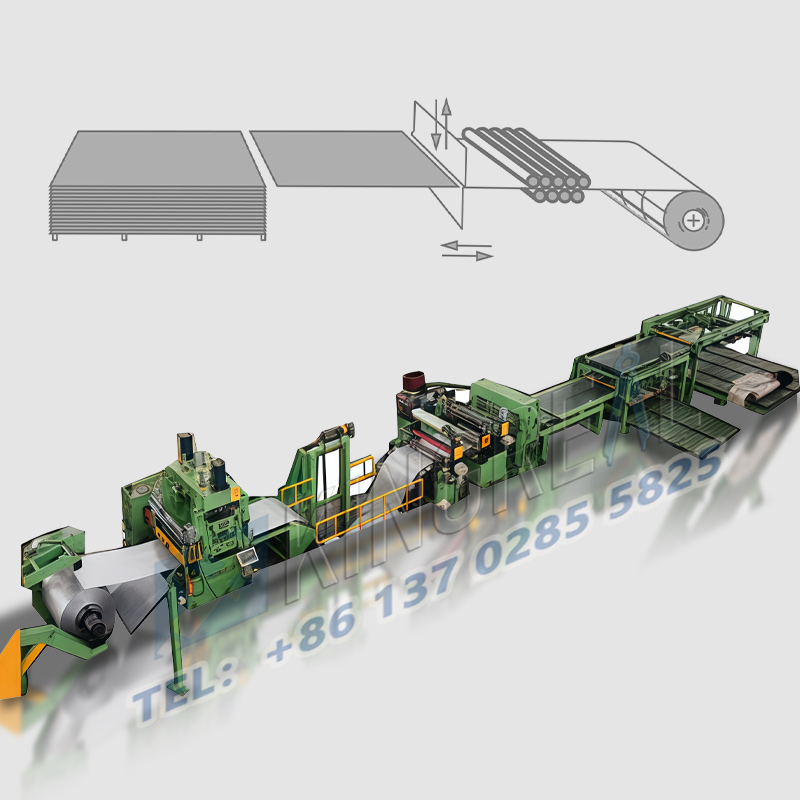
Technical Logic Behind High-Efficiency Cutting in Metal Cut to Length Lines
The reason metal cut to length machines achieve efficiency levels far surpassing traditional equipment lies in the system-integrated design of the entire production line. The metal cut to length line consists of multiple distinct technical modules, with each component playing a critical role in the production process.
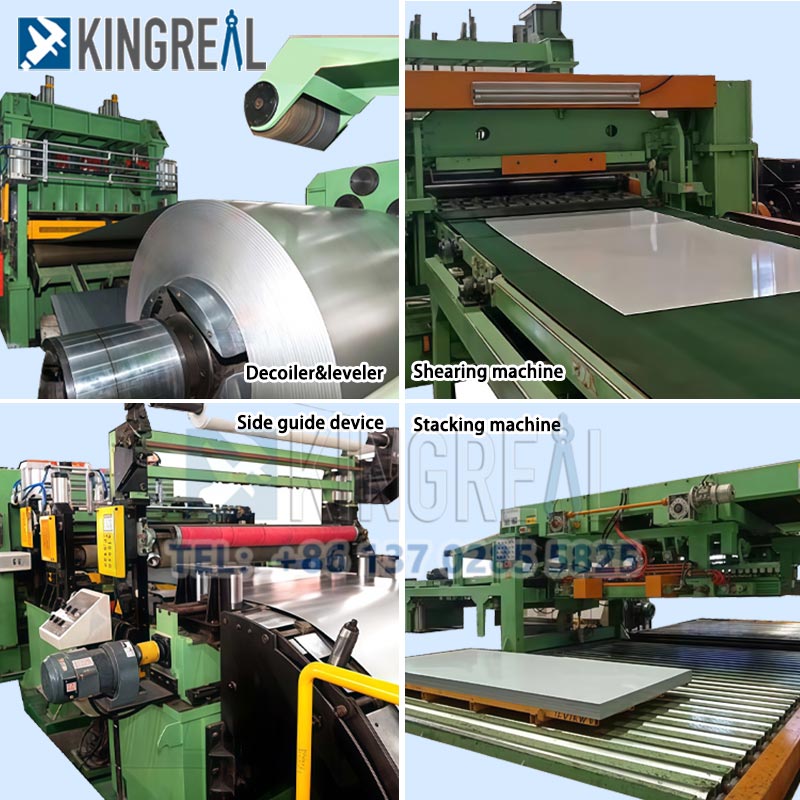
1. Decoiler
Used to support large metal coils and feed them steadily into the subsequent processing zone.
-Stability: High-quality decoilers are typically equipped with hydraulic expansion systems that firmly grip the coil from the inside diameter, preventing shifting or loosening during high-speed unwinding.
-Tension Control: The decoiler regulates unwinding tension via an auxiliary hold-down arm and a variable-frequency drive system.
Stable tension output is fundamental to ensuring the metal strip enters the leveler flat, effectively preventing wrinkling or stretching deformation during transport.
2. Leveler
The leveler is a critical piece of metal cut to length machine that determines the quality of the finished sheet.
During long-term storage, metal coils develop internal stresses, leading to issues such as coil set, wavy edges, or center buckling upon unwinding.
-Stress Elimination: The leveler employs multiple sets of staggered leveling rolls to subject the passing metal strip to alternating bending actions. This process eliminates internal residual stresses in the metal through multiple precision deformation steps that exceed the material's yield limit.
-Roller Configuration: Depending on material thickness and strength, KINGREAL SLITTING levelers can be configured with 4-high or 6-high roller structures featuring hardened roller surfaces. The high-precision leveling process ensures the sheets remain perfectly flat after shearing.
3. Cut-to-Length Machine
The shearing machine cuts the continuous metal strip into sheets of specific lengths according to preset parameters.
-Cutting Modes: Modern metal cut to length machines can be equipped with various cutting methods, including stop shear, flying shear, or swing shear.
-Cut Quality: Shear blades made from high-strength alloy materials (such as Cr12MoV) ensure clean, burr-free cuts with minimal dimensional tolerances, thereby reducing the need for secondary trimming.
4. Stacker
Located at the end of the production line, the stacker collects the finished sheets after cutting.
-Automated Stacking: The stacker uses pneumatic or vacuum suction technology to neatly stack sheets onto pallets.
-Surface Protection: For scratch-prone materials like stainless steel or aluminum, the stacker can feature air-float conveyance; sheets move on a cushion of air, avoiding direct friction with mechanical components and preserving the surface finish.
5. Control System
Typically utilizes a combination of a PLC (e.g., Siemens or Mitsubishi) and a Human-Machine Interface (HMI).
-Parametric Production: Operators simply input the cut length, quantity, and processing speed via the touchscreen, and the system automatically coordinates the synchronized operation of all components.
-Sensor Monitoring: The metal cut to length line is equipped with numerous laser displacement sensors and encoders to monitor material position and movement speed in real-time, ensuring every sheet meets precise dimensional standards.
Key Advantages of Metal Cut to Length Lines in Metal Manufacturing
1
Automatic Feeding and Material Guiding System
●No Manual Intervention Required: The automatic feeding system uses servo motors to precisely control the feed length.
By utilizing a loop bridge within the production line, the system automatically balances the speeds of uncoiling and shearing.
●Material Guidance: Heavy-duty conveyor belts or roller assemblies accurately lead the metal material through every step of the process, therefore preserving constant centerline alignment and lowering the chance of downtime produced by material misalignment.
2
High-Speed Operation and Time-Cost Optimization
●Continuous Production: Unlike standalone shearing machines, the metal cut to length machine achieves seamless integration of uncoiling, leveling, shearing, and stacking. This assembly-line approach eliminates waiting times associated with material handling between stages.
●Rapid Changeover: The system supports recipe storage; when switching processing specifications, operators simply recall preset parameters, and the metal cut to length line automatically adjusts guide widths and cut lengths, significantly reducing setup and changeover times.
3
Cutting Precision and Material Utilization
●Millimeter-Level Precision: Automated cutting, monitored by sensors, keeps length tolerances within ±0.3mm.
High precision ensures every sheet meets the rigorous standards of downstream processes, preventing scrap caused by dimensional errors.
●Waste Reduction: Through precise calculations, automation technology maximizes the utilization of every inch of the coil, minimizing production waste.
4
Production Safety and Environmental Risk Control
●Man-Machine Separation: As the metal cut to length machine handles multi-ton coils and performs high-frequency shearing, workers monitor operations remotely from a control console, drastically reducing the risk of workplace accidents.
●Emergency Stop Protection: The metal cut to length line integrates safety light curtains and infrared sensors; upon detecting unauthorized entry or material jams, the system triggers an emergency stop within milliseconds to prevent equipment damage and personnel injury.
The metal manufacturing industry is evolving toward greater intelligence and precision. The metal cut to length machine not only tackles problems of poor accuracy and low efficiency in conventional techniques but also offers trustworthy technical backup for reducing material loss and improving operational safety by combining uncoiling, levelling, cutting, and stacking operations.
Whether for automobile manufacturing, household appliance manufacture, steel structure building, or stainless steel processing, a high-efficiency metal cut to length line is a major tool for increasing output capacity.
KINGREAL SLITTING is dedicated to providing comprehensive metal cut to length machine solutions, covering everything from design and manufacturing to installation and commissioning. We offer specialized, customized solutions tailored to various material thicknesses and types.
If you are looking for ways to enhance your factory's processing efficiency, please feel free to contact us. KINGREAL SLITTING offers professional consultation services through multiple channels:
●Online Consultation: Our engineers are available online to answer questions regarding metal cut to length line selection and technical specifications.
●On-site Visits: We cordially invite clients to visit the KINGREAL SLITTING factory for a firsthand inspection, allowing you to observe the metal cut to length machine's operation and processing precision up close.